Growing August Beauty Gardenia as a Hedge: Spacing Guide
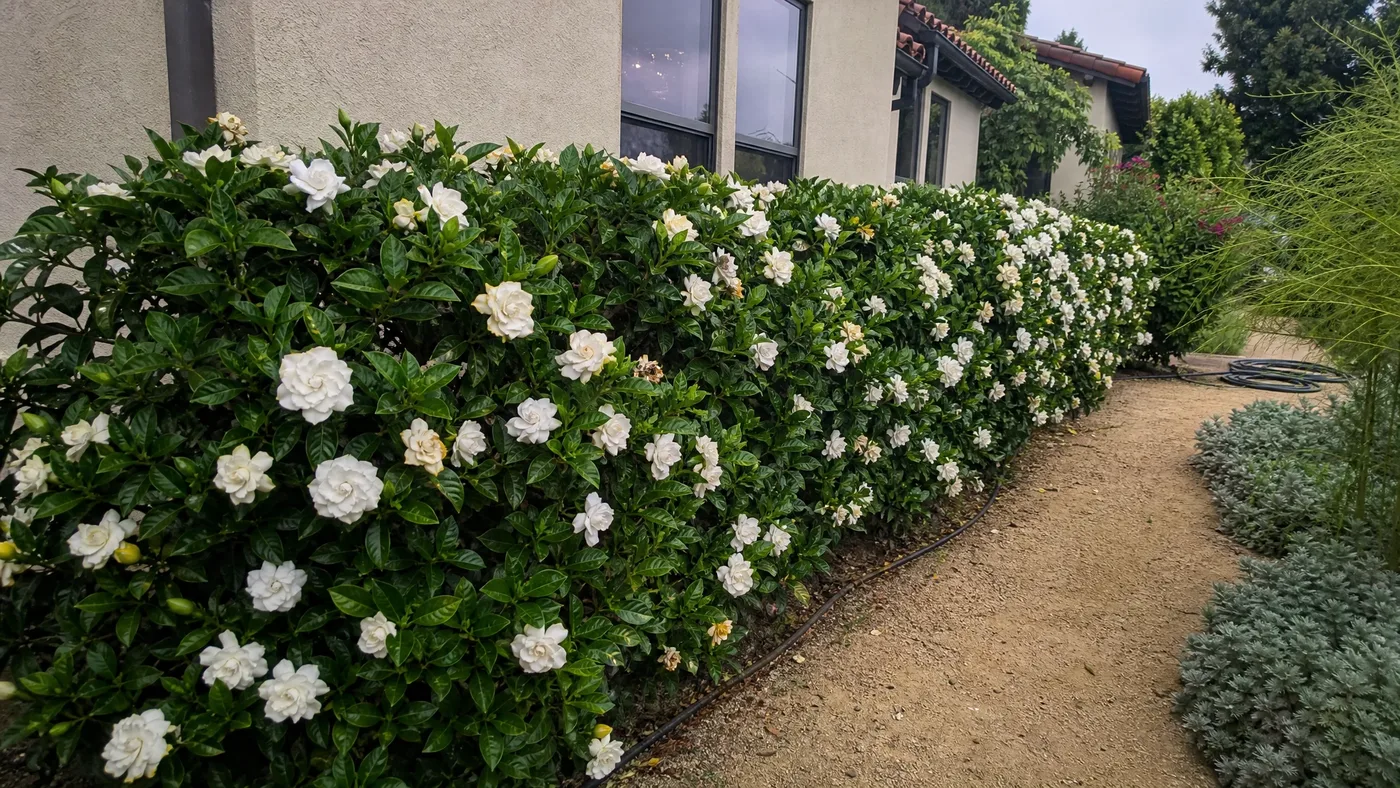
Picture a 30-foot garden path with glossy evergreen leaves brushing your knees on both sides. In early summer the air is heavy with the scent of creamy, double blooms about 3 inches across. That is a gardenia hedge in full flower, and it starts as a bare strip of lawn.
Many people assume a hedge means cramming in as many plants as will fit, or that gardenias are too fussy to line up like boxwood. What we see instead is that August Beauty, at 4 to 6 feet high and 3 to 4 feet wide, builds a dense, fragrant hedge once the spacing is right. Below, you'll find out all about planning one from scratch, including the spacing math, planting along a string line, first-year pruning, and whether it suits a privacy screen or a clipped low hedge.
Planning a 30-Foot August Beauty Gardenia Hedge
We will follow one example from start to finish: a 30-foot strip of lawn running along a walkway. Here are the starting numbers and the two checks that decide whether the plan works.
The goal is an evergreen, flowering hedge about 4 to 5 feet high that lines the path and smells wonderful in summer. The bed will be 4 feet wide, which gives the shrubs room at their full 3 to 4 foot spread.
Reading the Light
Stand on the strip in the morning and again in mid-afternoon, and note where the sun falls.
Our strip gets morning sun and shade from the house after lunch. That matches Clemson's advice to plant gardenias in light to partial shade, preferably with morning sun and afternoon shade. If your strip bakes all afternoon, expect more leaf scorch and more watering. Our sun requirements guide covers the trade-offs in detail.
Checking the Soil
A hedge is only as even as its soil, so test before you buy a single plant.
Gardenias want acid soil, with pH below 6.0 according to NC State and between 5.0 and 6.5 according to the University of Florida. Test the whole 30 feet, not one spot, because lawn soil near a concrete path is often more alkaline. If one end reads high, you will see it later as yellow leaves with green veins on those plants only. Our soil and pH guide shows how to correct it before planting.
Doing the Spacing Math for August Beauty Gardenia
Spacing for a hedge comes from one number, the mature width. The arithmetic is short, so work it through before you stake anything.
NC State lists 'August Beauty' at 4' to 6' high and 3' to 4' wide. The species can reach 8 feet, so do not use species figures for this cultivar. For a deeper look at those numbers, see how big August Beauty really gets.
- Take the narrow end of the width range, 3 feet, as your center-to-center spacing. A hedge should knit together, so you want neighbors touching at maturity.
- Divide the run by the spacing: 30 feet divided by 3 feet gives 10 plants.
- Set the first and last shrubs half a gap, or 1.5 feet, in from the ends. Your marks fall at 1.5, 4.5, 7.5, 10.5, 13.5, 16.5, 19.5, 22.5, 25.5 and 28.5 feet.
- Keep the line at least 2 feet back from the path edge, which is half the widest mature spread. Closer than that and the blooms will lean over the walkway.
Tight or Roomy? Picking the Spacing
The 3-foot answer is a choice, not a law. This table shows what other spacings would mean for the same 30 feet.
| Spacing | Plants for 30 feet | What you get |
|---|---|---|
| 2 feet | 15 | Fastest solid wall, but crowded and costly |
| 2.5 feet | 12 | Quick fill, little room for airflow later |
| 3 feet | 10 | Touching by maturity, with some air between stems |
| 4 feet | 7, with 2 spare feet | Best airflow, but gaps linger |
Common advice says to plant every shrub at its full mature width. For a hedge we disagree. At 4 feet apart you stare at gaps for seasons, and for a path-side hedge that is a lot of bare mulch.
We also would not go below 3 feet. The University of Florida advises enough space for good air circulation, which helps with pest prevention and lets the scent spread. We often see crowded gardenias lose leaves on the inside of the row, where the air stays still.
Our example takes 3 feet and 10 plants. It is tight enough to look like a hedge within a few growing seasons, and loose enough to breathe.
Setting Out August Beauty Gardenia Along the String Line
With the numbers settled, planting is mostly careful marking. Work in the cool part of the day and set every shrub the same way. Our planting guide covers a single shrub in more detail.
Mark the Line and the Holes
Straight lines are what make a gardenia row read as a hedge instead of a row of shrubs.
Drive a stake at each end of the strip and pull a string tight, 2 feet from the path edge. Measure along the string from one end and mark each position with a flag or a dab of spray paint. Step back to the path and sight down the line before you dig. Moving a flag is easy, moving a shrub is not.
Dig and Set Each Shrub
Every hole follows the same rule: wide, but not deep.
Remove the sod from the whole 4-foot bed first, so grass does not compete with the young roots. Dig each hole wider than the root ball and no deeper. Set the top of the root ball slightly above the surrounding soil, because gardenias dislike sitting wet. Face the best side toward the path, backfill with the native soil, and firm it gently.
Our August Beauty plants arrive well rooted and ready to plant, so all ten can go in during one afternoon.
Water in and Mulch
The last steps protect the roots while the row settles.
Water each plant slowly until the soil is soaked through, then spread a layer of mulch over the whole bed, keeping it off the stems. Walk the line one more time and straighten any shrub that leans. Check the bed weekly through the first season, since young plants have no reserves.
Pruning Year One for a Dense Green Wall
Pruning a gardenia hedge is a matter of timing. Cut at the wrong moment and you trade a green wall for one without flowers. Our pruning guide has the general rules, and here is how they play out in the first year.
Leave the First Spring Alone
Resist the urge to shape new plants right away.
At planting, remove only broken or dead stems. Clemson lists the main bloom for May through June, with sporadic flowers through the summer, so let the shrubs flower and settle in without interference.
Tip After the First Flush
Once the main flush fades, it is time to build density.
Cut off the spent blooms and tip back the longest shoots to just above a leaf pair. That makes each stem branch, which fills the gaps between plants. Keep the top slightly narrower than the base so sunlight reaches the lower leaves. Light shearing is plenty, so do not cut into bare wood.
Stop Before the Buds Set
The calendar matters more than the shears.
Arkansas Extension notes that gardenias set their flower buds in the fall before going dormant, and that waiting until August to prune will hurt the main bloom the next summer. Finish by the end of July. October is the absolute cutoff, but we like the earlier date for a hedge.
Privacy Screen or Formal Low Hedge?
At 4 to 6 feet tall, August Beauty sits between the two ideas. Here is what our example tells us about each use.
As a Privacy Screen
A screen needs height, and that is where this cultivar tops out.
Even at 6 feet, it will block the view at eye level but not into a second-story window. It also fills in from the base, so it hides a low fence or an air-conditioning unit well. For a tall barrier, look to something bigger. For a soft, fragrant boundary, it is excellent. Gardenias also resist deer, which helps along a boundary.
As a Clipped Low Hedge
Formal clipping works, with a cost.
Because buds form on the growth you would trim, hard shearing reduces flowers. A formal 4-foot hedge is possible, and customers usually ask us how tight it can be kept. Our answer is to clip once after the first flush and accept fewer blooms. Our landscape uses guide shows how to pair it with boxwood for structure.
Our example stays informal at roughly 4 to 5 feet, because the path is the point and the flowers are why we planted it.
The Finished Hedge of August Beauty Gardenia in Bloom
A few seasons on, the bare strip is unrecognizable. Here is what you can expect from the example at maturity.
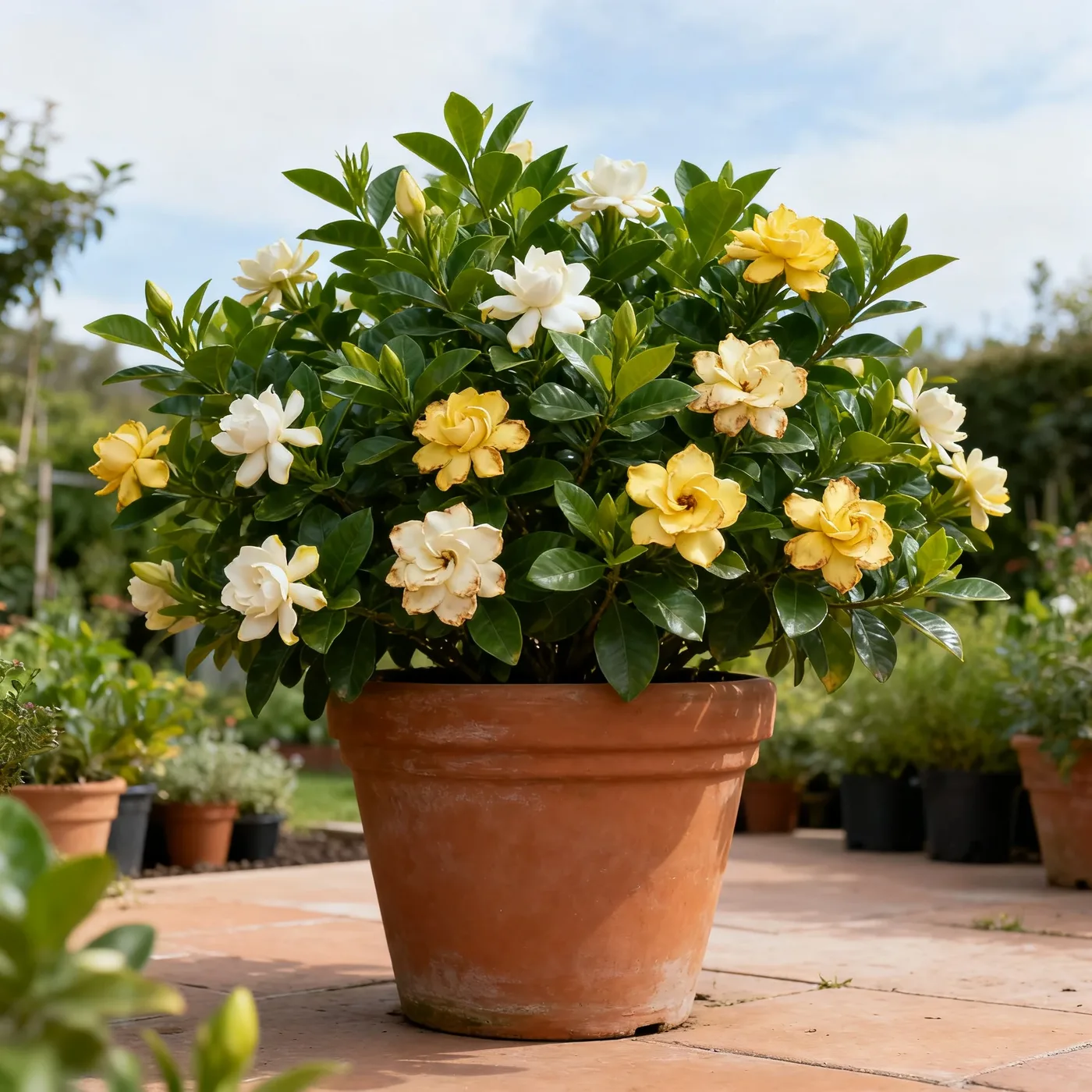
Ten shrubs now meet shoulder to shoulder along 30 feet. The species grows at a medium pace, so patience pays here. The leaves are deep, glossy green all year, and flowers appear late spring through summer. Each double bloom opens creamy white, then ages to yellow, so you see several shades on one branch.
Walk the path on a warm evening and the scent arrives before the flowers do. The airflow we planned for in the spacing step carries that fragrance down the line. Along the string line you laid out, every position now holds a rounded, full shrub, and the ten marks have become one continuous hedge.
Your 30-Foot August Beauty Hedge in Full Bloom
Return to that strip in early summer: 30 feet, 10 plants at 3-foot centers, pruned once after the first flush and never after July. The green wall is thick, the double blooms are open, and the path smells sweet from end to end.
August Beauty Gardenia
Nursery-grown August Beauty Gardenia in sizes from 1 Gallon, shipped to your door.
From $33.97
Shop Now →Every August Beauty we ship leaves our farm in a pot matched to its root system, firmly packed against bumps in transit, so it comes out of the box ready to go straight onto your string line. We are a small business, and we like knowing each plant has what it needs for its first season in your hedge.