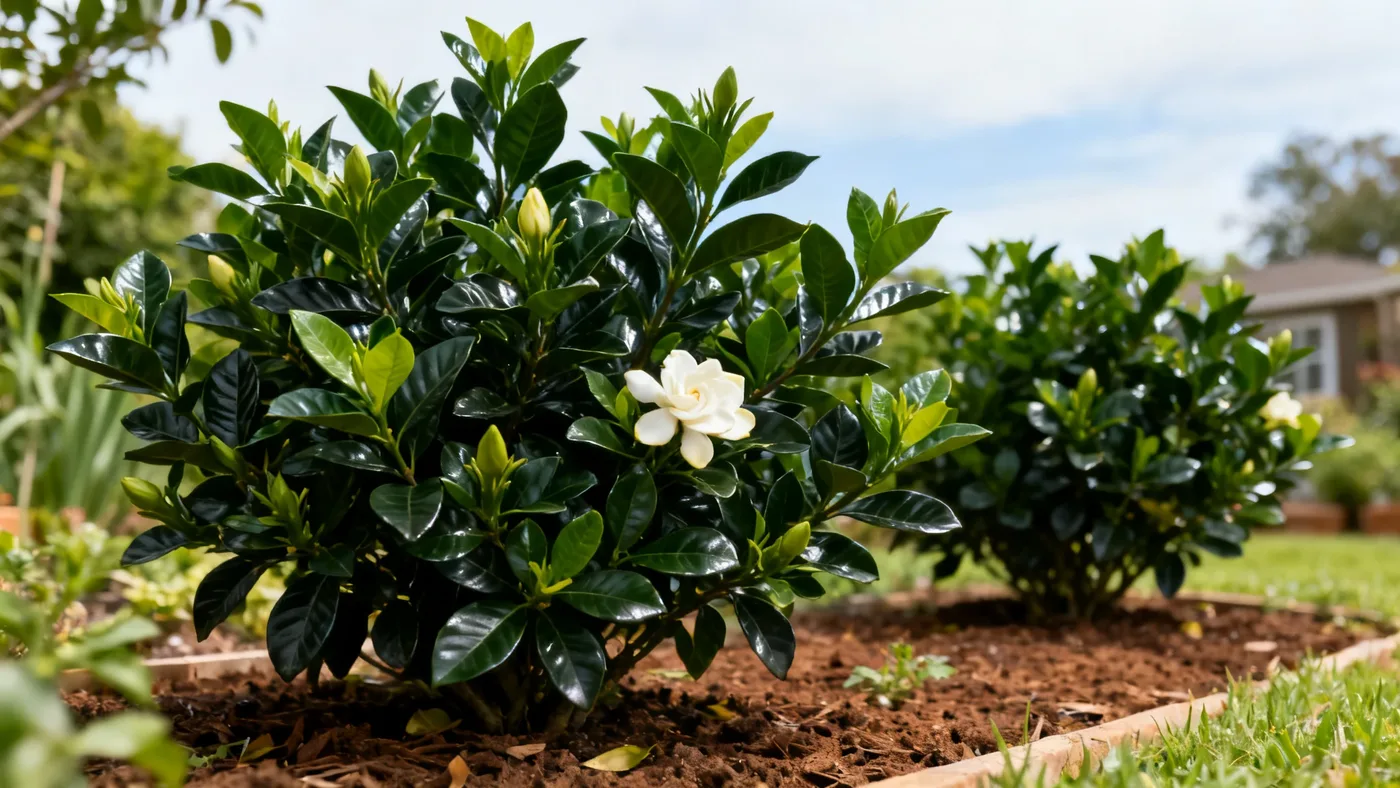
Fertilizing August Beauty Gardenia: What, When and How Much
August Beauty Gardenia thrives on regular feeding, but the approach matters far more than the frequency. Feed too much nitrogen and you'll get lush foliage but few flowers. Feed with the wrong pH and leaves yellow while the plant starves. Get the timing and formula right, and you'll support consistent blooms from late spring through summer.
This guide walks you through exactly what to feed, when to feed, and how to apply it so your gardenia reaches its full potential.
Why August Beauty Gardenia Needs Specialized Feeding
August Beauty Gardenia is an acid-loving shrub, meaning it needs soil on the acidic side (roughly 5.0 to 6.5 on the pH scale) to properly absorb nutrients, especially iron. Regular all-purpose garden fertilizers often tip soil toward neutral pH, which locks up iron and triggers chlorosis, the yellowing of leaves while veins stay green. A specialized acid-loving fertilizer prevents that problem and delivers nutrients in forms gardenias actually use.
Your August Beauty Gardenia also grows at a moderate pace, roughly 6 to 12 inches per year, and will reach a mature size of 4 to 6 feet tall and wide. That steady, controlled growth needs balanced nutrition, not a heavy nitrogen diet that encourages soft, weak growth.
What Fertilizer Is Best for August Beauty Gardenia
Use an acid-loving plant fertilizer formulated for azaleas and camellias. These products are specifically designed for plants that thrive in acidic soil and come with a lower pH than standard fertilizers. Look for products labeled "azalea and camellia fertilizer" or "acid plant fertilizer."
The NPK ratio (nitrogen, phosphorus, potassium) should be relatively balanced. Avoid high-nitrogen formulas, which promote leafy growth at the expense of flowers. A ratio like 10-6-4 or 12-4-8 works well.
Keep chelated micronutrients, especially iron chelate, on hand. If your gardenia's leaves start yellowing despite adequate moisture and fertilizing, iron deficiency is the culprit. Iron chelate corrects the problem quickly.
When to Fertilize August Beauty Gardenia
Timing is critical when fertilizing August Beauty Gardenia. The plant flowers heavily in late spring and early summer, with lighter, sporadic blooms into fall depending on your climate. You'll feed twice during the growing season to support this flowering pattern.
First feeding: Early spring, as new growth emerges. This gives the plant nutrition to fuel the upcoming bloom flush.
Second feeding: Right after the first heavy bloom flush, typically after early summer. This supports the plant's energy reserves and encourages sporadic repeat blooms.
Stop fertilizing by late summer. Feeding late in the season encourages tender new growth that won't harden off before frost. In zones 7b through 10, frost protection is important depending on your exact location, so let the plant slow down naturally as days shorten.
How to Fertilize August Beauty Gardenia: Step-by-Step Instructions
1. Water the Plant First
Never apply fertilizer to dry soil. Water your gardenia thoroughly 1 to 2 days before fertilizing. Wet soil buffers the fertilizer and helps roots absorb nutrients without burning. The plant should have consistently moist (not waterlogged) soil, which is its normal preference anyway.
2. Check the Fertilizer Label for Application Rate
Rates vary by brand and concentration. Read the label carefully. For most acid-loving liquid or granular fertilizers applied to a 4 to 6 foot mature shrub, you'll use roughly 1 to 2 tablespoons of granular product dissolved in water, or follow the liquid dilution instructions exactly.
3. Apply Granular Fertilizer Around the Base
If using a granular product, sprinkle it evenly around the base of the plant, keeping it 3 to 4 inches away from the main stem. Gardenias have shallow root systems, so you want the fertilizer where feeder roots can reach it, not pressed against the trunk.
For a 4 to 6 foot shrub, create a circle of fertilizer about 2 feet out from the stem. Scratch it lightly into the top inch of soil with a small hand fork or cultivator, then water thoroughly.
4. Or, Apply Liquid Fertilizer
If using a liquid concentrate, dilute it according to label directions and apply to the soil zone around the plant's base. Pour slowly so the soil absorbs it rather than running off. Liquid fertilizers work faster than granular but need more frequent reapplication (usually every 3 to 4 weeks during the growing season).
5. Water Deeply After Application
Water thoroughly after applying any fertilizer. This helps carry nutrients into the root zone and prevents concentration burn. Your gardenia should receive consistent moisture, never allowed to dry out completely.
August Beauty Gardenia Fertilizer Schedule by Season
| Season | Timing | Action | Notes |
|---|---|---|---|
| Early Spring | When new growth emerges | First feeding with acid-loving fertilizer | Supports upcoming bloom flush |
| Late Spring / Early Summer | After first heavy bloom period | Second feeding with acid-loving fertilizer | Encourages repeat blooms |
| Mid to Late Summer | As needed only | Iron chelate if leaves yellow | Address chlorosis promptly; avoid excess nitrogen |
| Fall and Winter | No scheduled feeding | None | Plant enters dormancy; extra fertilizer causes frost damage |
Common Fertilizing Mistakes to Avoid
Mistake 1: Using regular all-purpose fertilizer. Standard garden fertilizers are formulated for a wider pH range and often lack the iron that acid-loving plants need. They can gradually shift your soil toward neutral, triggering chlorosis. Stick with azalea and camellia formulas.
Mistake 2: Applying fertilizer to dry soil. Fertilizer on dry soil can burn roots and won't be absorbed efficiently. Always water the plant thoroughly before feeding.
Mistake 3: Fertilizing too late in the season. Feeding in late summer and fall encourages tender new growth that freezes back in winter, weakening the plant and delaying spring blooms. Stop by mid to late summer.
Mistake 4: Overfertilizing for blooms. High-nitrogen fertilizers produce leafy plants that rarely flower. A balanced acid-loving formula is all your gardenia needs. More is not better.
Mistake 5: Ignoring yellowing leaves. If new growth comes in yellow with green veins, iron deficiency is setting in. Apply iron chelate immediately rather than waiting for the plant to recover on its own.
Troubleshooting: Yellow Leaves and Poor Blooms
Yellowing leaves (chlorosis): If leaves yellow while veins stay green, the plant cannot absorb iron. This happens when soil pH is too high. Apply iron chelate or chelated micronutrients according to label directions. You can also acidify the soil by working in sulfur or coffee grounds around the plant's base over time. Check that your soil is genuinely acidic (roughly 5.0 to 6.5 pH). If you're unsure, a simple home pH test or local extension soil test will confirm.
Few or no blooms: Bud drop or sparse flowering can come from multiple causes. Check that the plant receives full sun to part shade; in very hot climates, morning sun with afternoon shade is ideal. Ensure consistent moisture, as underwatering stresses buds. Avoid pruning in late summer or fall, which removes next year's flower buds. And make sure you're not over-fertilizing with nitrogen, which shifts the plant's energy to leaves instead of flowers.
Pale or stunted growth: This usually signals a nutrient deficiency beyond iron. Make sure you're feeding in early spring and after the first bloom flush. If growth remains pale even after fertilizing, a soil test through your local extension service can identify which nutrients are actually low.
For more detailed care across the whole growing season, see our August Beauty Gardenia care guide. If you're new to growing this plant, check which zones support August Beauty Gardenia to confirm your climate is a good match.
Quick Reference: Fertilizing Checklist
- Use acid-loving (azalea/camellia type) fertilizer, not all-purpose
- Apply in early spring as growth emerges
- Apply again after the first heavy bloom flush (typically early summer)
- Water the plant thoroughly before fertilizing
- Keep fertilizer 3 to 4 inches away from the main stem
- Water deeply after application
- Stop fertilizing by late summer to avoid frost damage
- Keep iron chelate on hand to treat yellowing leaves
- Avoid high-nitrogen fertilizers, which reduce flowering
- Test soil pH if yellowing persists despite iron treatment